Am I shadowbanned on X? How to check and what to do

Photo by RDNE Stock project on Pexels
There's no single switch on X (formerly Twitter) that you can check to find out whether you've been shadowbanned, and "shadowban" isn't a word X uses. What X does describe is a range of ways it can limit how far a post or an account travels, from keeping a post out of search to temporarily limiting what an account can do.
This guide explains what X's own help pages say about limiting reach, six checks you can run on your own account without any third-party website, why shadowban test sites can't give you a real answer and what to do if X has restricted you. Everything here comes from X's Help Centre and official blog, linked as we go. Where X hasn't documented something, we say so.
The short answer
- "Shadowban" isn't X's term: X talks about limiting or restricting reach, and says it doesn't limit content based on your views or opinions.
- Rule-breaking posts may be labelled: X describes visibility labels that tell authors and viewers when a post's reach has been limited, and says authors can appeal them.
- Formal account limits come with a notice: if your account is locked or its features are limited, X says you'll see a message and may get an email. Other changes to reach may not be announced.
- Not everything is announced: X says spam detection, quality ranking and experiments can also reduce reach, and it doesn't offer a full list of what affects your account.
- Shadowban test sites can't see X's internal systems. Never give one your password.

What X says about limiting reach
X's page How we enforce our rules says that when a post breaks the X Rules, it may restrict that post's reach. It lists what that can mean:
- keeping the post out of search results, trends and recommended notifications
- removing it from the For you and Following timelines
- moving it lower down in replies
- restricting likes, replies, reposts, quote posts, bookmarks, sharing, pinning or editing
The same page describes labels, introduced in April 2023, "informing both post authors and viewers that we limited the post's visibility", and says authors can submit an appeal on the label. X's 2023 blog post Freedom of Speech, Not Reach explains the idea behind this: rather than removing every rule-breaking post, X can leave it up but make it harder to discover. Not every drop in reach necessarily comes with a label.

Labels aren't the whole story. X's page About specific instances when a post's reach may be limited gives other reasons a post may travel less far:
- Low quality or the law. X may limit a post that breaks its rules or applicable laws, or that it judges to be low quality.
- Spam detection. Some posts that don't show up may have been identified as spam by X's systems.
- Quality ranking. Potentially abusive and low-quality replies are collapsed, though X says they're "still accessible to those who seek them out". X also says its ranking uses signals based on behaviour, such as whether people block or mute you.
- Safe search. Search removes potentially sensitive posts, and posts from accounts the searcher has blocked or muted.
- Experiments. X says it runs experiments that may limit the reach of certain posts.
These don't all come with a label or a notice, and X doesn't publish the details of how its ranking works for individual accounts. So a quiet week isn't proof that you've been restricted, and the absence of a label isn't proof that you haven't.
How to check your own X account
These checks only use X itself and a friend.
- Look for notices in the app and your email. X's page on locked and limited accounts says you'll see a message such as "We've temporarily limited some of your account features" or "Your account has been locked", and that X also emails the address on your account. Check your spam and junk folders too.
- Open your recent posts and look for a label. If X has limited a post for breaking its rules, it says the label is shown to you as the author.
- Ask a friend to search for you. Ask someone who doesn't follow you, and who is logged in, to search for a distinctive phrase from one of your recent public posts, then tap Latest. If they can't find it, that alone doesn't prove you've been restricted.
- Check how your replies appear. Ask the same friend to open a thread you replied to recently. If your reply is collapsed or tucked away lower down the thread, X may have ranked it as lower quality. That's a ranking decision, not necessarily a penalty on your account.
- Check your sensitive media setting. See the steps below.
- Check whether your posts are protected. In the app, tap your profile photo, then Settings and privacy, then Privacy and safety, and look under Audience and tagging at Protect your posts. X says protected posts can only be found in search by you and your followers, so someone who doesn't follow you won't see them.
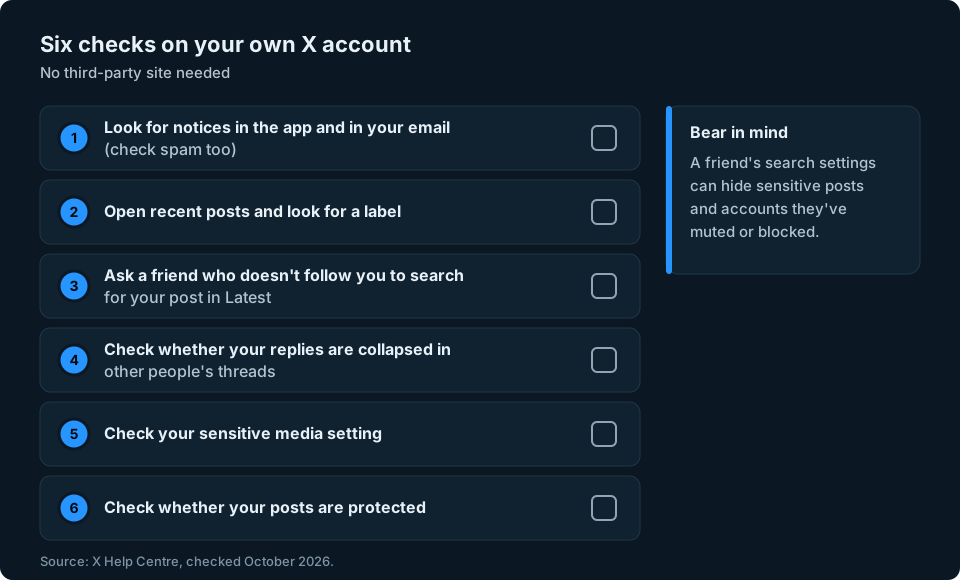
Bear in mind that your friend's own settings affect what they see. If they've muted or blocked you, or their safe search hides sensitive posts, your post may be missing for reasons that have nothing to do with your account.
Check your sensitive media setting
If you post photos or videos that could be seen as sensitive, X has a setting that marks them as such. These are the steps from X's Your media settings page for the app:
- Tap your profile icon.
- Tap Settings and privacy, then Privacy and safety.
- Tap Your posts.
- Look at the toggle next to Mark media you post as containing material that may be sensitive.
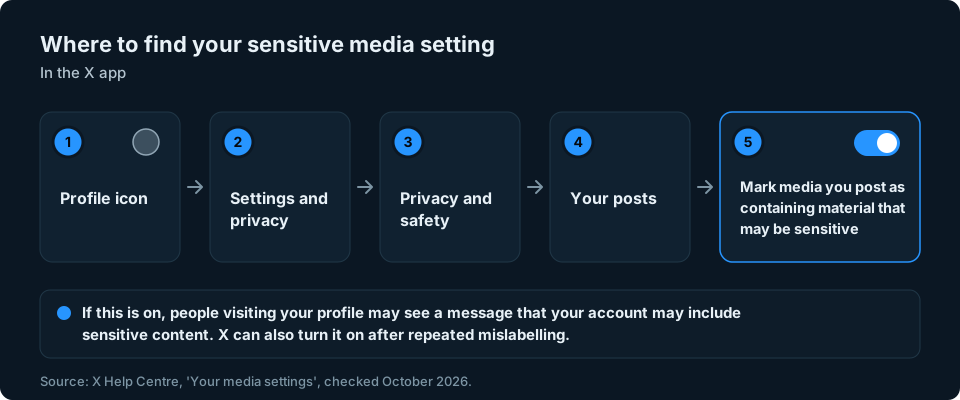
X says that when this is on, people who visit your profile may see a message that your account may include potentially sensitive content. It also says that if your media is repeatedly reported and found to be unmarked, X may switch this setting on for you and label your account. Combined with safe search hiding potentially sensitive posts, that can make you harder to find.
What about shadowban test websites?
Plenty of websites offer to test whether you're shadowbanned. We haven't tested them, so we won't name any. But it's worth knowing what they can and can't do.
X's help pages don't describe a public shadowban status that outside websites can check, or any way for them to find out why an individual post ranks lower. A test site may look at public search results and other visible information, but that can't confirm whether X has restricted your account. Your friend can run the same kind of public search check for free in check 3 above.

If you do try one, check a few things first. It should never ask for your X password. It should have a privacy policy that says what it does with your username. And it shouldn't charge you to "remove" a shadowban, because only X can lift a restriction.
What to do if your reach has been limited
What you can do depends on what you found:
- A label on a post. Read what it says. X says authors can submit an appeal on the label if they think X wrongly limited the post's visibility. It doesn't publish step-by-step instructions, so look for the appeal option where the label appears. You can also delete the post if you'd rather move on.
- A locked account. X says you'll be asked to verify your account by phone, email or reCAPTCHA.
- A limited account. Follow the instructions X shows you. Depending on the restriction, X says you may be able to verify your phone number or email address, or use X in a limited state for a set time. Some limits mean only your followers can see your activity. If you think it's a mistake, X points you to its support form.
- No notice at all. X suggests reporting posts that aren't appearing through its help forms, and says it announces technical problems on its @Support account.

Since X says spam detection can affect whether posts show up, look at your own habits too. X's Authenticity policy rules out things like repeatedly posting identical or nearly identical posts, sending bulk unsolicited replies and following then unfollowing large numbers of accounts to inflate your follower count. Avoid these rather than trying to work around a possible restriction.
When your follower growth stalls
Most people start wondering about a shadowban because their numbers have stopped moving. A restriction can play a part: if your posts are kept out of search and timelines, fewer new people see them and fewer follow you. But growth also slows for ordinary reasons, like posting less, a change in topic or a busy news week drowning everything out.
Watching your follower count over time helps you see when growth slowed and compare that with what you posted. It won't tell you whether X restricted your reach, but it gives you a clearer picture than a single day's figures. Our guide to tracking your X follower count shows you how. If you're keeping an eye on X alongside other accounts, we're working on something to make that a lot less fiddly. Sign up at the top of this page to hear when it's ready.
Frequently asked questions
Does X shadowban accounts?
X doesn't use the word, but it does limit reach. Its help pages say it can keep rule-breaking posts out of search and timelines, limit accounts and rank low-quality replies lower, while saying it doesn't limit content based on your views.
How can I tell if I'm shadowbanned on X?
Look for notices in the app and your email, check your recent posts for labels and ask a friend who doesn't follow you to search for your posts in Latest. X doesn't offer a full list of every ranking decision on your account.
How long does a shadowban last on X?
X doesn't publish one time limit. It describes account limits as temporary, while labels apply to individual posts, which you can appeal or delete.
Do shadowban checker websites work?
They may check public search results and other visible information, but that can't confirm why X has reduced a post's reach. X doesn't document a public shadowban status for these websites to check. Never give one your password.
Why are my replies hidden on X?
X says it collapses replies it considers potentially abusive or low quality, although they're still accessible to people who seek them out. X also uses signals such as blocking and muting when ranking replies, so a reply lower down doesn't necessarily mean your account has been penalised.
Does marking media as sensitive reduce reach on X?
It can make you harder to find. X says safe search removes potentially sensitive posts from search results, and visitors to your profile may see a message about sensitive content.