Why am I losing followers on Instagram? 7 reasons and what to do
Photo by Sanket Mishra on Pexels
You open Instagram and your follower count is lower than yesterday. Sometimes it is a handful of people, sometimes hundreds. Either way, the app does not tell you why.
This guide covers seven common reasons, how to work out which one is most likely on your account and what you can actually do about it. Instagram does not always give you enough information to be certain, so treat these as possible explanations to check, not a diagnosis.
First, is it a sudden drop or a slow slide?
The pattern matters more than any single day.
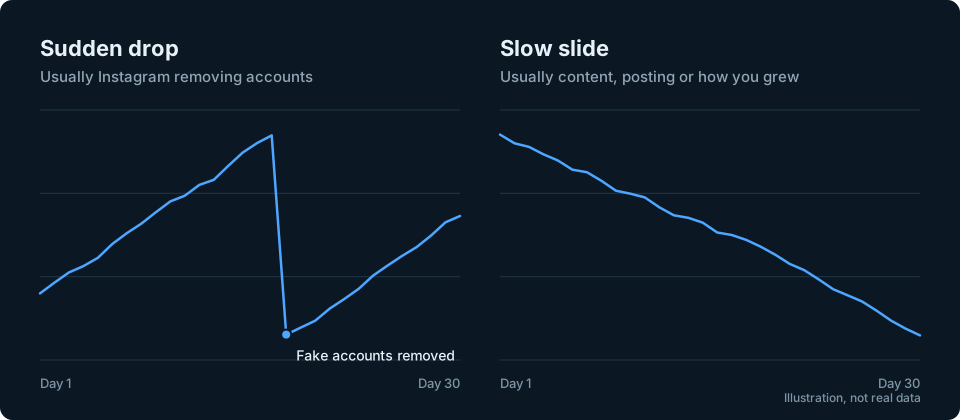
- A sudden drop is a noticeable fall over a day or two, after which things carry on as normal. Account removals and reactions to a single post usually look like this.
- A slow slide is a steady loss over weeks. That is more often about your content, how often you post or how you grew in the first place.
What your follower loss might mean
| What you notice | Possible explanation |
|---|---|
| Hundreds gone overnight, reach and likes unchanged | Instagram removing inactive or fake accounts |
| A dip the day after a particular post | People reacting to that post |
| A drop a week or two after a giveaway | Prize hunters leaving |
| A small loss most days, but you still grow overall | Normal unfollowing |
| A steady loss and fewer new followers | Content drift, posting less or follow for follow unwinding |
| Fewer new followers and much lower reach | A recommendation restriction on your account |
Why did I suddenly lose Instagram followers overnight?
The most likely cause of a large overnight drop is Instagram removing accounts. Instagram regularly deletes spam accounts and bots and clears out accounts that have been inactive for a long time. When they go, they vanish from your follower count too.
This happened at scale in early May 2026, when accounts such as Cristiano Ronaldo's and Kylie Jenner's lost millions of followers within a day or two. A Meta spokesperson put it down to a routine process for removing inactive accounts and said active followers were not affected. Smaller creators reported losing a few per cent.
How to tell: search for news of follower drops on the same day, or ask other creators if theirs fell too. If many accounts dropped at once and your likes, comments and reach look normal, a cleanup is a reasonable explanation. Those accounts were not watching your posts anyway, so your real audience has not changed.
1. Inactive and fake accounts were removed
This is the cleanup described above, and it can also happen quietly in smaller batches. You do not need to do anything. Your engagement rate (likes and comments as a share of followers) often looks better afterwards, because the people who never engaged have gone.
2. Bought followers are being cleaned out
If you, a previous social media manager or an agency ever bought followers, expect them to disappear over time. Most are fake accounts. Some are real but low quality accounts that follow thousands of others and never engage. Either way, buying followers breaks Instagram's rules.
Ten thousand followers are not much use if only a few hundred are real people who watch your videos, share your posts or buy from you. Let the bought ones go.
3. Follow for follow is unwinding
If you grew by following lots of accounts in the hope they would follow back, many will unfollow you later. Some people use apps that automatically unfollow anyone who does not return the follow within a few days. This shows up as a slow slide rather than a single drop, and it eases off once those connections have worked through.
4. Giveaway followers are leaving
A giveaway can bring in a burst of people who want the prize, not your content. Check the date: if the losses started a week or two after the winner was announced, that is your answer.
Next time: make entry depend on something that shows real interest, such as answering a question about your work in the comments, rather than just following and tagging friends.
5. Your content drifted, or you posted less
If someone followed you for photography tips and you have spent the last month posting promotional offers, do not be surprised if a few people leave. The same goes for going quiet for weeks, or suddenly posting five times a day.
What to do: look back at the posts you made when growth was strongest. What were they about, and how often did you post? That is usually the best guide to what your audience wants.
6. One post put people off
A strong opinion, a hard sell or something far off your usual subject can trigger a cluster of unfollows, normally within a day of posting. It is not always a mistake. Some posts are worth losing a few followers over. But it is worth knowing which ones cost you, so check what you posted just before any dip.
7. Your account has a restriction
A restriction does not usually remove your existing followers. What it does is limit how often your posts and profile are recommended to people who do not follow you yet. The result is fewer new followers, so your normal day to day unfollows are no longer covered and the total starts to fall.
How to check: in Instagram, open Settings and activity, then Account Status. It shows whether any of your content broke the rules and whether your account can currently be recommended to non-followers. If something is flagged, you can usually request a review there.
While you are at it, never give your Instagram password to third-party apps that promise to show who unfollowed you. Logging in through them can look like suspicious activity to Instagram.
How to see your follower trend in Instagram Insights
If you have a professional account (creator or business), Instagram shows more than the headline number:
- Go to your profile and tap Professional dashboard.
- Open Account insights, then the Followers section.
- Choose a time period, such as the last 30 days.
- Look at Follows and Unfollows over that period, and at which days had the most unfollows.
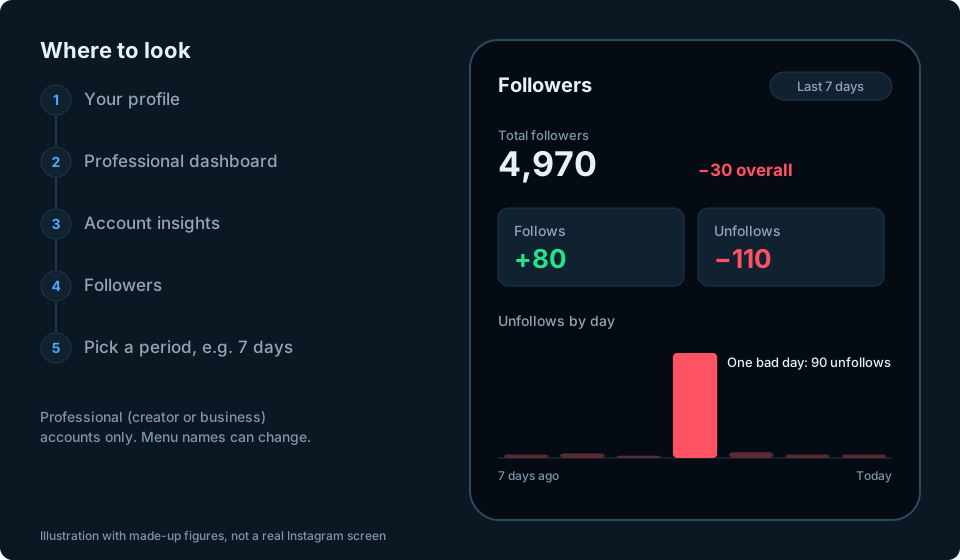
This tells you whether a fall came from one bad day or a steady trickle, which is the most useful clue you can get. If you have a personal account, you can switch to a professional account for free in settings.
A worked example
Take the account in the illustration above. It started the week with 5,000 followers, gained 80 and lost 110, so the total is down by 30.
The headline figure looks bad, but the more useful question is how those 110 left. If 90 disappeared on a single day that lines up with news of a cleanup, the account is in good health and simply lost accounts that were never real. If the 110 left steadily, about 15 a day, something about the content or the way the account grew is worth looking at.
Is it normal to lose followers every day?
Yes. Every account loses some followers every day as people tidy up who they follow, close their accounts or lose interest. What matters is your net change: followers gained minus followers lost.
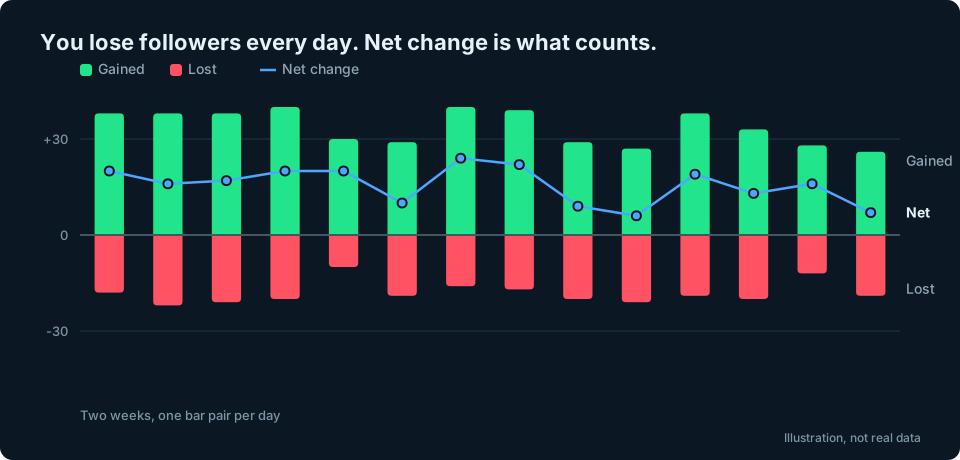
If your net change is positive over a week or a month, you are growing, even if you lose a few people on any given day.
Quick checklist
- Is it a sudden drop or a slow slide?
- Did other accounts report drops on the same day?
- Are your reach, likes and comments steady or falling?
- Did you ever buy followers, use follow for follow or run a giveaway?
- Has what you post, or how often, changed recently?
- Did one post come just before the dip?
- What does Account Status say?
The honest answer
Instagram does not tell you who left or why, so you will not always get a definite answer. A sudden drop that lines up with reports of a cleanup, while your engagement stays steady, is usually nothing to worry about. A steady decline over weeks is the one to investigate, starting with your follower trend in Insights and the posts you made around the time it began.
Either way, the pattern over time tells you far more than any single day's number. Keeping an eye on it across all the accounts you run is exactly the problem we are working on with GridStats.